Showing posts with label Bolivia. Show all posts

Sunday, 21 April 2013

Messi in La Paz

Our time in La Paz was largely spent adjusting to being in a city after a month in the jungle - and a city that really likes to party at that. We were lucky enough to meet up with some great friends in the highest capital city in the world, Rae and Stephen Mickey from Parque Machia, and also Gilbs and K-Wottz (from way back in December, the wonderful couple we camped with on the beach in Chile). We stayed in one of the infamous party hostels of the city, a couple of nights in the Wild Rover, and then a couple at the Loki. We prefered the Loki as it seemed to be a more mature crowd, though the shots still flowed at all times of the day! They are famous for their 'bloodbombs', similar to a jaegerbomb but with vodka and a red colouring - really wakes you up, and really gets you drunk!


We spent many an hour exploring the markets of La Paz, and bought an obscene amount of alpaca (mainly me, mainly socks) along with some other things, like a wooden recorder and a wonderful hand woven throw for when we finally get a house and settle somewhere...may be in storage for a while! We also explored the witches market here (I have stolen some photos from Gilbz and K-Wottz as we didn't have our camera on that day) - where they sell charms and bottled potions for various things; luck, wealth, travel, health... there are also haggard old crones (Dave´s words!) selling palm readings and fortune telling on the roads. We thought this was a bit of a tourist trap, but on further investigation they actually refuse to offer their services to tourists, because they believe they are sacred and an important part of their culture - not to be used for our Western amusement - which I give them serious kudos for. The main thing tourists take away from the witches market is the baby llama foetus', which are sold to be buried under new houses or buildings to bring luck and prosperity. At first I wasn't sure they were real, but I have since been convinced otherwise (and I was till too suspicious to touch one!).


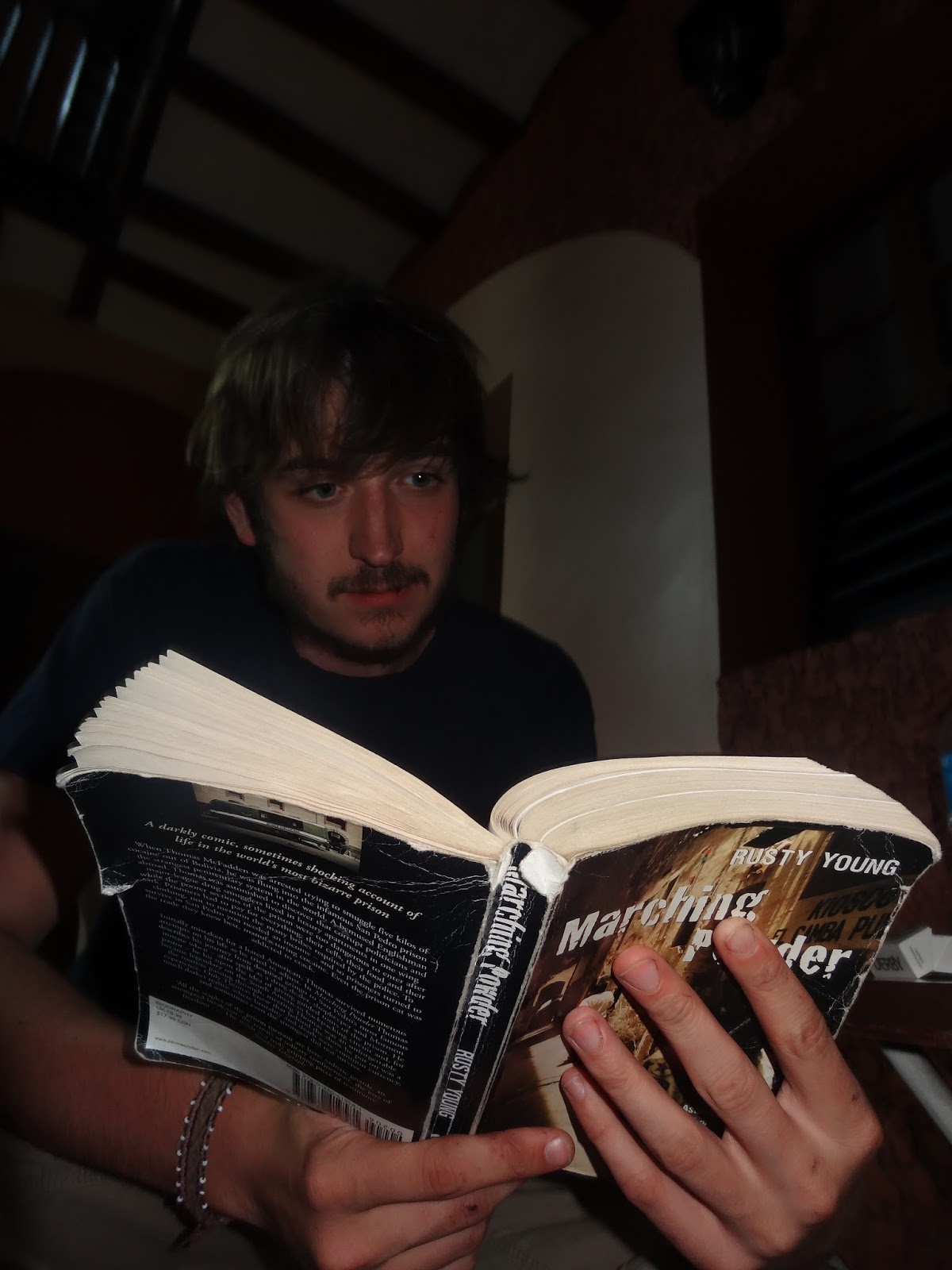
We also attempted to be allowed in to San Pedro prison, after both having avidly read the popular book The Marching Powder before reaching La Paz, but unfortunately (or very possibly quite fortunately) the guards were having none of it, and even stopped people taking pictures. I managed a sneaky one though.


The coolest thing we did in La Paz was get tickets and go to a Bolivia V Argentina football game. I'm the first to admit I'm not a football fan, but I got involved. We all bought (fake) football shirts and got hyped up - we were pretty shocked and appalled to find that there was no alcohol served in the stadium, but it turned out the atmosphere and group spirit of the Bolivians didn't need any more fuel! The game itself was good, ending in a 1-1 drawer. We were sat in the Bolivian side, but behind several Argentinans, which added to the enjoyment and the banter between sides. One of the strangest things I noticed was that between halves, the referees were escorted on and off the pitch by armed policemen. All the boys were very happy because they got to see Messi, and our seats were pretty close. I hear he's the best in the world, but  I'm mates with Gazza so was pretty far from star struck. 


We had hoped to go to the Bolivian side of Lake Titicaca, Copacabana and Isla del Sol, but unfortunately there were horrendous road blocks, and we heard some nightmare tales from other travellers. And plus our Bolivian visa was up, so after an emotional Goodbye to Rae, we were off to Puno, Peru. 

PS - If you are reading this, please comment, it encourages me to keep it up to date!


Wednesday, 3 April 2013

Inti Wara Yassi - Parque Machia

For our next month of travels, we had planned to go and volunteer with animals. I was hoping for a big cat, and Dave was a little dubious, and not really sure what to expect. We had heard about this great organisation, Inti Wara Yassi, which three refuge centres for wild animals around Boilvia. We headed to the first of the Parks, in a place called Villa Tunari - not really knowing what to expect, but committing ourselves to one month to find out. Due to massive landslides, we didn't arrive at the park until pretty late at night, so the official volunteer co-ordinater was not around. Luckily, Francessca and Or, two very long term volunteers were able to show us to a spare room. A spare room covered in roaches, spiders, ants, and with a token bat flying around inside. We quickly put up the mosquito net, and tried to sleep in the unbearable heat, hoping the next day showed the place in a better light...

The next morning we were given a tour by Suzanne, the volunteer co-ordinater. She gave us a brief history of the organisation, and a tour of the various sections. The park consists of: a clinic, for sick animals; Quarenntine, for monkeys in cages (and some on runners), mainly Capuchins; Small Animals, like Tejons, Foxes, Birds, Spider Park, The Mirador (Capuchins), 2 Ocelots, 2 pumas, and one bear. The animals are all there for different reasons - Balu's mother was shot, and he was kept as a pet until he became too dangerous, when he was given to the park. Many of the monkeys came from similar stories, used as pets and horrifically mistreated by humans, some from circuses. The aim of the park is to rehabilitate the animals so eventually they can be wild again - with many this has been possible, but for some they have too much of an attachment to humans to be set free. After the tour, Suzanne told us which animals we would be working with. I was to spend a month in Spider Park, which I Was over the moon about - once I'd seen all the animals, I didn't care where they put me (though I was secretly glad it wasn't birds). And Dave was to be working with Balu the Bear. 


So I'll sum up the month pretty quickly, as it's impossible really to put in to words how much we loved the park. For me, the feeling of working 11 hour days in the middle of the jungle, surrounded by 32 Spider Monkeys (only 5 of which were on cord, the rest free), and getting to know their faces, names and personalities is something I'll never forget - and I really hope I can come back for a longer period of time in the future. For Dave, the adreneline rush of walking a bear through the jungle every day, and his attachment to the animal was really special. 


The whole way in which the Park is run makes it a real community. Everyone gets what they put in - helping in any way possible at any time. Everyone is filthy and exhausted at the end of every day, but still able to carry a 10l container of alcohol back to one of the hostels and get a party going - one of the high points being a spectacular Christmas party in March! Over the month we made some really good friendships (shout out to Tanja!) - and we hope to see a lot of you again, give us a shout when you're in Peru! 

We both agree it was one of the best months of our lives, and definitely the coolest thing we've ever been a part of. For anyone thinking of travelling Bolivia - this really is a must!

PS. Thanks Rae + Gedge for some photos!


Monday, 1 April 2013

Potosí

Potosí was once one of the most important cities in the world,due to the rich Cerro Rico mountain. Throughout the 15th and 16th centuries silver was mined in abundance, and shipped to European countries - thus the city itself never really saw any of the wealth it boasted. The mines of the Cerro Rico mountain are still very much in use today - though it is not just silver, but tin and other minerals the workers look for now.  

Potosí is the highest city in the world - at an altitude of 4,090m above sea level, and is often described as being 'harrowing' and 'shocking' to tourists, although is also described as a must see. We however loved the city, and found it rich in history and culture. The narrow streets, intricately designed churches and crumbling buildings are surviving echoes of the wealth the city once held, and we particularly enjoyed finding doorways with family crests atop of them, though faded and forgotten now. It is aspects like this which have made the city a UNESCO Heritage Site. 


We signed up to embark on a tour of the mines, with a company run by former miners. We had heard from many that the tour is not for the faint hearted, and I was pretty scared before going in. The guide we had put us at ease straight away, and although sharing some shocking facts with us (over 8million people have died in the very mountain we were entering!) we felt like we were in safe hands. There were just four of us on the tour, and our first stop was to get dressed in mining clothes, boots and safety hats.


 After a brief stop at the Miners Market, to buy some coca leaves and sample some 98% alcohol (I can still feel the burn), we were taken to see the process of making the silver. We were told how the people that work in these places are not allowed to do so for very long because of the dangerous working conditions. As well as being crowded, they are in constant contact with poisonous chemicals, such as cyanide and mercury. 


We were then taken in to the mine itself. We went on a Sunday, so there were no miners working at the time we went in (though tours do run every day). This made it feel a little safer, though the impact of the heat and the fumes inside were so intense, I can only imagine it would be 10 X worse if there were people working. Our guide showed us the veins in the wall of the mine which miners follow, and took us down to the depth of the mine. There were times where we had to soldier-crawl through the maze of the mine, with protection over our noses and mouths from the poisonous fumes. The heat was almost unbearable, and we had to stop to rest a lot. The air supply was of course limited, and as we were at such high altitude, it was pretty difficult to move very fast or far.


We were shown a demonstration of dynamite - the boys went in to a separate tunnel, and I waited for the BANG - the mine shook and they had to run back quickly because of the fumes and dust. Dynamite is sold legally in Potosi, and on a working day you would be able to hear the explosions echoing around the moutain. In the mines, the miners worship Tio - the devil. They are religious people on the outside, attending church and raising Christian families, but inside the mine they say is like entering hell, and God does not reach them inside. Each mine has a statue of Tio,which they offer gifts to daily (cigarettes, alcohol, coca leaves) as an offering in return for him keeping them from harm in the mines.


After about 3 hours we made our way towards the exit, and never before have we truly understood the phrase ´the light at the end of the tunnel'. We were so grateful to see the daylight, and breathe in lungfulls of fresh air when we reached the exit. The conditions of working in the mines are extremely harsh, and most miners don't live to be past 40. Many contract silicosis. There are children as young as 14 who work in the mines of Cerro Rico, as the work pays three times as much as the average Bolivian job. The visit here was truly shocking, harrowing, and very thought provoking.


See the film 'The Devil's Miner' for a real account of working in the mines.

Saturday, 23 March 2013

Carnaval de Oruro

We were lucky enough for a trip to Oruro to all be sorted out for us by our fellow students at Me Gusta. For a great price, we were taken to Oruro, given a guided tour, seats for the carnaval and breakfast included. We had a great group of people, and had a spectacular time. The city of Oruro is pretty desolate, although it still manages to rival Rio Carnaval with the amount of tourists it attracts. We were told the city is in constant competition with Rio, and had only revealed a month before our visit a giant statue of the Virgin Mary, which now takes the title of the biggest religious statue on the continent.


For the Carnaval we all donned costumes - masks, wigs, glitter - and of course ponchos to tone down the annoyance of waterballoons. Actually we found out that in Oruro water balloons are not the done thing - it was cans of spray foam which were king there, and the battles throughout the day were brutal and merciless. One of the girls on our tour was actually allergic to the foam, so in her case perhaps it was!


The Carnaval itself was indescribable. The costumes, the dances, the vibe and the atmosphere was so warm and bright, and it went on long in to the evening where the costumes became lit with fire, the music so loud you could feel it thumping through you.  Unfortunately our camera fell from the rafters on the afternoon of the first day, so we have no photographs of the evening time or of the Sunday.


Staying in Sucre

After working for Mauricio in Tarija, we headed to the beautiful city of Sucre where we took Spanish lessons. We started with a school called Me Gusta, which was a relaxed and friendly atmosphere, 4 hours lessons a day and homework each evening. We got extremely lucky with our teacher, Coco, who was so warm and friendly, and we hit it off immediately. So much so that when he told us he was leaving the school to start out on his own - we also left the school and started private lessons with him. He was a great teacher, stopping our lessons to take us to the market and throw us in the deep end, giving us his favourite Bolivian recipes for us to cook in the evening - and the best part, when our camera was destroyed at carnival, he took us shopping for a new one, so we weren´t charged with tourist tax.


Sucre is a beautiful city, and a place where it is so easy to lose track of time. Everyone we met there had been there for 3+ weeks, and every traveller we´ve met since then has spoken of losing time in Sucre. The market sold the most delicious fruit smoothies and salads, the freshly baked bread enticed everyone that walked past with the smells, and it was one of the busiest and vibrant places we´ve seen so far. We spent a wonderful three weeks in the city, learning Spanish, meeting some very cool people, and celebrating some Bolivian festivals - the build up to Carnaval, and the celebration of Pachamama, Mother Earth.


While we were in Sucre it was the build up to Carnaval, which means that everywhere you go you are likely to get bombarded by children with water guns and water balloons, from every angle imaginable. We hastily wised up and had fun every time we left the house, ducking behind cars and old Bolivian women to avoid getting soaked. The school had a roof balcony which overlooked the street, and needless to say we spent many hours getting our own back and soaking passers by, who looked outraged to be revenged by gringos. We were told that Oruro was the biggest and best place to celebrate Carnaval in Bolivia, so that´s where our next stop was...


Thursday, 14 February 2013

¡Feliz Año Nueve!

Firstly...apologies for the wait inbetween posts, I will be playing catch up over the next week and hopefully should be up to date soon!

After arriving in Uyuni at the end of December, we were presented with the option of heading to La Paz, the messy party heavy capital of Bolivia for New Years Eve with the rest of our chums from the tour. After some deliberation, we decided that decided that skipping most of the country on an overnight bus for a night which is usually a phenomenal let down wasn´t something we were willing to do. So we booked a bus to the city of Tupiza - most famed for being the place where Butch Cassidy and the Sundance Kid met their fatal end (the one thing my Dad knows about Bolivia is the scene in the film where they step off the train...not so far from the reality we faced!). We met a newly married couple on the bus who were spending their year long honeymoon travelling around the world, from horseriding across the Mongolian Steppe to spending the Myan end of the world at Isla del Sol - needless to say they were very cool.


 So on the final evening of 2012, we four decided to meet for dinner and drinks and see what was happening. The setting of the city was beautiful, surrounded by mountains of multiple colours, and a real cowboy-esque place.  The town itself was pretty dire and desolate - the first restaurant we went to (difficult to chose as they all looked the same and had the same menu) took half an hour after we´d ordered to tell us they were out of the wine and the beer we´d requested and only had the most expensive one, so we moved to another. The service was equally slow, but with a couple of cocktails down us (the boys stuck to beer) we were happy to put the world to rights and swap travelling and life stories. With our bellies full and our alcohol goggles on, we decided to head to the Plaza to see if any kind of celebration was to take place. We bought a couple of bevvies and sat around the fountain, where there was a congregation of Gringos expectantly gathering, and a couple of local kids letting off fireworks. 


At the countdown to midnight we all hugged and kissed, and heard a faint rumble of music coming from a sidestreet. Sure enough, within ten minutes, a small band of Bolivian men accompanied by little elderly women in costumes and ribbons dancing made it´s way round the plaza. People began to gather, and we followed. Within half an hour there were about three bands making their way around the plaza, each playing slightly different music, dressed slightly differently and with a different group of dancers. The alcohol was flowing and it wasn´t long until I was swept up in the arms of an old Bolivian man, with a wad of coca leaves in his cheek, swinging me round with a vice like grip. I looked round for Dave to help, and he had been whisked off by another!


By 1am the streets were alive, crammed with people and so many different bands dancing and parading their way round the plaza. We were all drunk, blind with happiness that the start to 2013 was something so magical, unexpected, culturally different, and evidence of a whole city being completely involved in making music, dancing and wishing each other all the staples of life for the new year; happiness, health, food and love.